
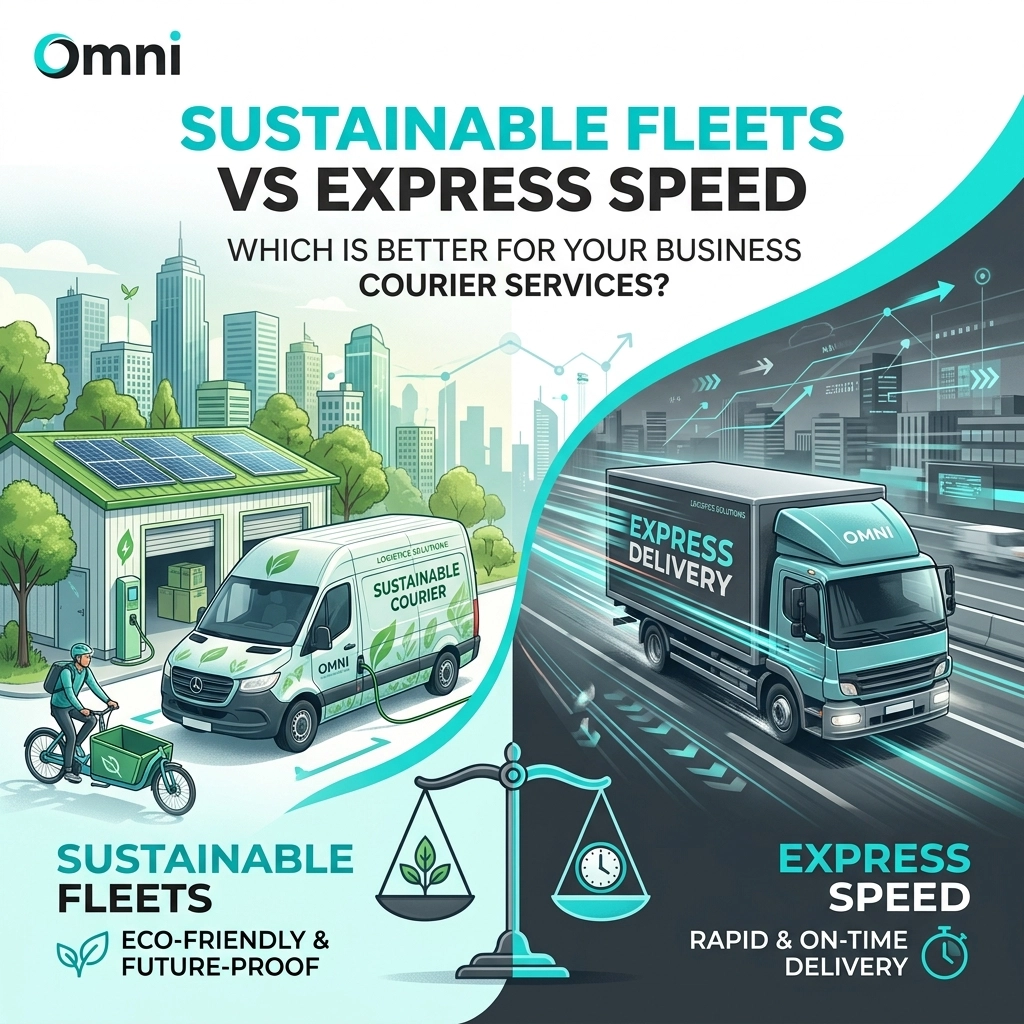
welcome to the big debate of 2026. if you’re running a business, you’ve probably felt the pull from two different directions. on one side, your customers want their stuff yesterday. they expect an express courier service that moves at the speed of light. on the other side, there’s a growing pressure to be green. you want to reduce your carbon footprint, use electric vans, and prove that your brand actually cares about the planet.
it feels like a choice you shouldn't have to make, but here we are. do you go for raw speed to keep the five-star reviews rolling in, or do you slow things down to keep the earth spinning? the truth is, the answer isn't "one or the other." it’s about finding the sweet spot where efficiency meets responsibility. at omni, we’ve spent a lot of time figuring out how to balance these two worlds, and we’re going to show you how to do the same for your business courier services.
express speed: satisfying the instant-gratification economy
let's talk about the need for speed. we live in a world where "waiting" has become a dirty word. when a customer hits that 'buy' button, a countdown starts in their head. if you can't offer an express courier service that delivers within 24 hours, you’re already behind the curve.
speed is often the primary driver of customer loyalty. it’s the reason people pay for premium memberships and why they’ll choose one online store over another. if your delivery is late, or even just "standard," you risk being forgotten. express delivery isn't just a luxury anymore; for many sectors, it’s the baseline. you need to hook your customers with the promise of fast arrival and then address that promise with a logistics partner who can actually deliver.
however, speed has a cost. traditionally, fast delivery meant more planes, more half-empty vans on the road, and a whole lot of wasted fuel. if you aren't careful, your quest for speed can lead to a messy strategy. you might find 10 reasons your parcel delivery strategy isn't working if you focus only on the clock and ignore the underlying logistics.

sustainable fleets: securing long-term brand longevity
now, let’s flip the coin. sustainability is no longer a "nice to have" badge you stick on your website. it’s becoming a requirement. governments are tightening up on low-emission zones, and carbon taxes are becoming a real factor in your bottom line. but more importantly, your customers are watching. they want to know that their package didn't cost the earth, literally.
investing in a business courier service that uses sustainable fleets, like electric vans and cargo bikes, is a move for the future. it tells your audience that you’re thinking about the long term. when you choose a greener path, you’re not just saving trees; you’re building a brand that stands for something. this is how you turn a one-time buyer into a lifelong advocate.
the challenge with pure sustainability is that, sometimes, "green" can mean "slow." if you’re consolidating shipments to save fuel, the delivery window might stretch. if you’re avoiding air freight for international shipping, your customers might be waiting days instead of hours. you have to be transparent. if you want to master this, check out how international shipping is explained to see how you can manage expectations without losing your mind.
takeaway: speed wins the sale, but sustainability wins the customer's heart. the trick is making sure you don't lose money trying to do both.
smart routing: achieving operational excellence
here is where the magic happens. the bridge between speed and sustainability isn't a slower van: it’s a smarter route. at omni, we don't think you should have to choose between being fast and being green. we focus on efficiency to solve both problems at once.
we operate through 5 key uk hubs that act as the heartbeat of our network. by strategically placing these hubs, we ensure that a parcel never travels a mile it doesn't have to. instead of a van driving across the country for one delivery, we use a hub-and-spoke model. this means we can group deliveries together, optimize the path, and cut out the "empty miles" that kill both your budget and the environment.
when you optimize your routing, you’re doing two things:
- you’re getting the parcel there faster because the driver isn't stuck in unnecessary traffic or doubling back.
- you’re burning less fuel, which makes your express courier service inherently more sustainable.
you should look for a partner that prioritizes this kind of high-level logistics. it’s the difference between a chaotic delivery day and a smooth, reliable operation. if you’re struggling with high costs, you might need to stop wasting money on shipping by looking at how your parcels are actually moving through the network.

hybrid models: balancing performance and responsibility
so, which is better? the answer is a hybrid model. your business doesn't have to be 100% one or the other. you can offer your customers a choice.
imagine your checkout page. you can offer an "eco-shipping" option that uses our sustainable fleet and consolidated routing for a lower price or a smaller carbon footprint. at the same time, you can offer a "priority express" service for those urgent "need it now" moments. this puts the power in the hands of the consumer.
using a hybrid approach allows you to scale. for a small business, trying to be everything to everyone is exhausting. but when you integrate a reliable courier service that handles the heavy lifting of routing and fleet management, you can focus on your product. we’ve seen that integrating a courier service into your online store can happen in minutes, giving you instant access to both speed and green options.
takeaway: don't force your business into a box. use smart logistics to offer speed when it’s needed and sustainability whenever it’s possible.
customer choice: increasing conversion rates
why does this balance matter so much? because it affects your conversion rate. a customer who cares deeply about the environment might abandon their cart if they see only high-speed, high-carbon shipping options. conversely, a customer in a rush will leave if they can't get express delivery.
by providing a range of business courier services, you are removing the barriers to purchase. you’re showing that you understand the diverse needs of your audience. you’re being reliable, and in the world of logistics, reliability is the ultimate currency.
at omni, we make sure that our 24/7 readiness supports this flexibility. whether it’s a midnight order that needs to be on a van by dawn or a bulk shipment destined for a more sustainable route, we have the infrastructure to handle it. our couriers are trained to be attentive and professional, ensuring that no matter which "speed" your customer chooses, the quality of the experience remains the same.

final thoughts: the future is efficient
the battle between sustainable fleets and express speed is actually a misunderstanding. the real winner is efficiency. when you work with a courier that uses advanced routing, maintains a modern fleet, and operates through a tight network of hubs, the conflict disappears.
you can be fast and you can be green. it just takes a bit of planning and the right partner. stop looking at logistics as a cost center and start looking at it as a way to define your brand. whether you are sending one parcel or a thousand, the way they travel says everything about who you are as a business.
if you're ready to level up, dive into the ultimate guide to business courier services and see how we can help you bridge the gap.
summary of action steps:
- assess your audience: do they value speed or sustainability more? offer both to be safe.
- check your partner: ensure your courier uses hub-based routing to minimize waste.
- leverage technology: use real-time tracking and smart manifests to keep everything on track.
- stay flexible: use a hybrid model to adapt to changing regulations and customer vibes.
logistics doesn't have to be a headache. with omni, it’s just another part of your success story. let's get moving.


